When AI Becomes a Machine Identity
The hard part of enterprise AI security is no longer only what a model says, but what identity it uses, what it can reach, and which actions it can take.
The first wave of enterprise AI security was built around a familiar warning: do not paste confidential information into a public chatbot.
That warning still matters. It is no longer enough.
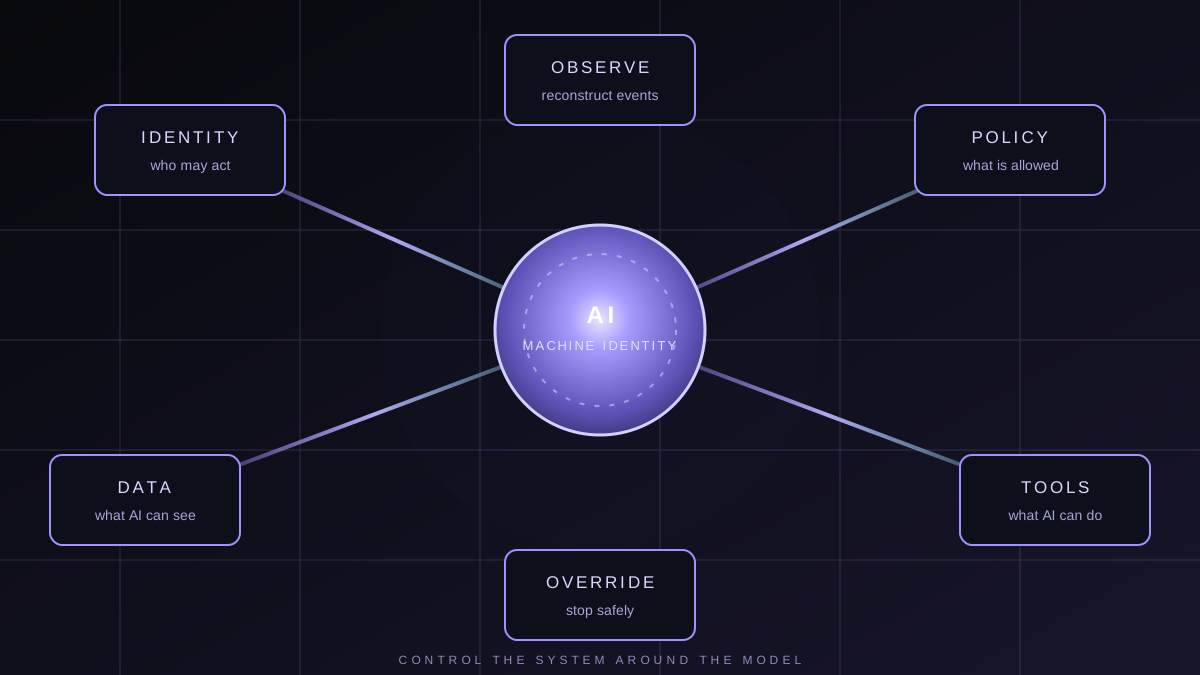
The more consequential shift is that AI systems are moving from tools that answer questions to systems that can retrieve data, invoke tools, and change other systems. Once that happens, the model is not just a conversational interface. It is part of a machine identity.
The model does not determine the risk. The architecture and the use case do.
A public assistant that summarizes a press release and an agent that can modify production records may use the same underlying model. Their risk profiles are completely different.
Start with four questions
For every AI implementation, answer these questions before discussing vendors or model benchmarks.
1. What can it see?
Map the data that can enter prompts, retrieval systems, logs, evaluation datasets, and external APIs. The list may include customer records, employee information, contracts, source code, email, databases, or transaction history.
This is the confidentiality boundary. It should be explicit, classified, and testable—not inferred from a system prompt.
2. What can it do?
A chatbot may only produce text. An agent may send email, create tickets, modify records, execute scripts, query a database, or change cloud resources.
The more an AI system can do, the less it should be allowed to decide without an independent control outside the model.
3. Under whose identity does it operate?
An AI workload may use a user session, an OAuth token, a service account, an API key, a managed identity, or a dedicated agent identity. Each option has different consequences for authorization, auditing, and incident response.
Treat agent identities as privileged machine identities. They need an owner, a purpose, a bounded permission set, and a lifecycle.
4. Can we reconstruct what happened?
For a high-impact action, the organization should be able to trace:
user → AI application → prompt → data retrieved → model output → tool call → action → resultIf that chain cannot be reconstructed, detection and response will be guesswork.
The control plane matters more than the prompt
Prompt filters can be useful, but they are not an authorization system. The model should never be the final authority on whether an action is permitted.
A safer architecture places controls around the model:
User
  ↓
Identity and access policy
  ↓
AI application / gateway
  ↓
Data authorization and DLP
  ↓
Model
  ↓
Tool authorization
  ↓
Approved enterprise systems
The model can recommend an action. A deterministic policy layer should decide whether the action is allowed, whether it needs human approval, and which identity performs it.
This separation is especially important for agents, retrieval-augmented generation (RAG), and tool protocols such as MCP.
Five boundaries that deserve special attention
Data boundary: authorize before retrieval
A RAG system should not retrieve every document and ask the model to decide what the user may see. Authorization belongs before retrieval.
user identity → authorization → permitted documents → retrieval → modelApply the same rule to vector databases, search indexes, cached context, and generated citations. A clean answer is not evidence that the underlying data path was safe.
Identity boundary: use task-specific permissions
Avoid giving an agent “whatever the user can access” unless that behavior has been deliberately designed and reviewed. Prefer a task identity with a narrow role.
For example, an invoice agent might be allowed to read invoices, read supplier details, and prepare a proposed payment. It should not be able to approve that payment. The approval is a separate responsibility.
Tool boundary: treat external content as untrusted
Prompt injection is not limited to a user typing “ignore previous instructions.” It can arrive through a webpage, document, email, ticket, or tool description that the agent consumes.
The practical response is layered defense:
- keep external content inside an explicit trust boundary
- validate model output before passing it to another system
- authorize tools outside the model
- restrict tools to an allowlist
- require confirmation for sensitive actions
- limit the amount of context exposed to each task
Supply-chain boundary: inventory the whole path
An AI application may depend on an SDK, an agent framework, a model provider, an embedding model, a vector database, a plugin, and one or more tool servers. The model file itself may also be an artifact that needs provenance, integrity checks, licensing review, and security scanning.
An AI asset register should record the owner, provider, model and version, deployment location, data classification, connected systems, identity method, risk tier, and approval status.
Observability boundary: log enough to investigate
For high-risk systems, capture at least:
- user and agent identity
- model and version
- prompt and response metadata
- retrieved documents or document identifiers
- tools invoked
- approvals and policy decisions
- actions performed
- policy violations
- token consumption and unusual activity
Prompts may contain sensitive information, so AI logs need their own access controls, retention rules, and redaction strategy.
Autonomy should shrink as impact grows
A useful operating principle is simple:
AI autonomy should decrease as business impact increases.
Automatic behavior is usually appropriate for summarizing public information or searching an approved knowledge base. Drafting an email may be automatic; sending it may require conditions. Modifying a customer record, resetting an account, changing a firewall rule, or transferring money should require a stronger approval path.
Deleting a production database should not be an available capability merely because an agent could technically call the API.
This is not an argument against agents. It is an argument for proportional autonomy.
A practical risk ladder
Classify systems by what they can see, what they can do, and the consequences of failure.
Minimal risk includes public-information search, writing assistance, and marketing brainstorming with no sensitive data.
Moderate risk includes internal document summarization, coding assistants, and enterprise knowledge tools.
High risk includes customer-facing systems, decision support involving sensitive information, fraud analysis, or workflows that influence people or money.
Critical risk includes privileged infrastructure agents, identity administration, autonomous financial transactions, and systems that can make irreversible changes.
A higher tier should trigger stronger requirements: a threat model, adversarial testing, continuous monitoring, human override, and a tested kill switch.
A minimum baseline for an organization starting today
- Keep an inventory of approved AI services and connected tools.
- Publish an acceptable-use policy with clear data classifications.
- Discover and manage Shadow AI instead of assuming it does not exist.
- Require enterprise authentication and MFA for managed services.
- Store API keys and other AI secrets in a vault; rotate them and assign owners.
- Give agents task-specific, least-privilege identities.
- Authorize users before RAG retrieval.
- Maintain an approved registry for MCP and other tool servers.
- Send high-risk AI activity to the organization’s monitoring platform.
- Require human approval for high-impact or irreversible actions.
- Extend incident response with agent disablement, credential revocation, and context preservation.
- Test prompt injection, tool misuse, data leakage, and privilege escalation before production.
How to organize the program
AI security works best as a shared governance capability, not as a security team project in isolation. Privacy, legal, risk, data, architecture, technology, and business owners each see a different part of the exposure.
A lightweight approval path can be enough for low-risk use cases:
use case proposed
  ↓
asset registered
  ↓
risk tier assigned
  ↓
fast-track or full assessment
  ↓
security / privacy / legal review
  ↓
pilot and adversarial testing
  ↓
production with monitoring
A useful reference stack is complementary rather than competitive:
- NIST AI RMF and the Generative AI Profile for risk management.
- ISO/IEC 42001 for an organizational AI management system.
- OWASP’s Top 10 for LLM Applications for application-level weaknesses.
- MITRE ATLAS for adversary behavior and threat modeling.
- The CSA AI Controls Matrix for control-oriented implementation.
- Microsoft’s agent identity guidance for identity design considerations.
No framework removes the need for judgment. Together, they help connect governance, architecture, application testing, and operational response.
The question to carry into every AI review
Do not stop at “Which model are we using?” Ask instead:
What can this system see, what can it do, which identity does it use, and how will we stop it when something goes wrong?
That is the difference between adopting AI as a feature and governing AI as an enterprise capability.